

What if the A$23,250 your firm potentially spends on manual AML/CTF compliance every year wasn’t actually a loss, but an untapped source of billable revenue? For many Australian professionals, the administrative weight of regulatory checks feels like a permanent drain on the bottom line. It’s a common struggle to reconcile the time spent on manual customer due diligence with the need to maintain healthy profit margins. By integrating dedicated compliance ROI tracking software, you can finally bridge the gap between regulatory necessity and financial performance.
We understand that the pressure of Tranche 2 requirements can feel overwhelming, especially when manual processes are already consuming your team’s most valuable hours. You’ve likely felt the frustration of opaque costs that are impossible to bill back to clients accurately. This guide provides a clear framework for calculating your compliance ROI and using automated billing support to recover AML/CTF costs. You’ll discover how to maintain audit-ready documentation without the manual labour, turning a complex transition into a distinct strategic advantage for your firm.
Key Takeaways
- Define compliance ROI as a strategic combination of risk mitigation, operational efficiency, and direct revenue recovery.
- Utilise compliance ROI tracking software to automate the recording of AML/CTF tasks, ensuring KYC and screening activities are accurately captured for billing.
- Transition from error-prone manual spreadsheets to integrated billing support modules that present regulatory costs as transparent line items.
- Learn how to embed ROI tracking directly into your initial client onboarding phase to capture value from the moment verification begins.
- Align your regulatory obligations with your firm’s financial health by leveraging automation to turn administrative requirements into measurable assets.
Defining the ROI of Compliance for Australian Firms in 2026
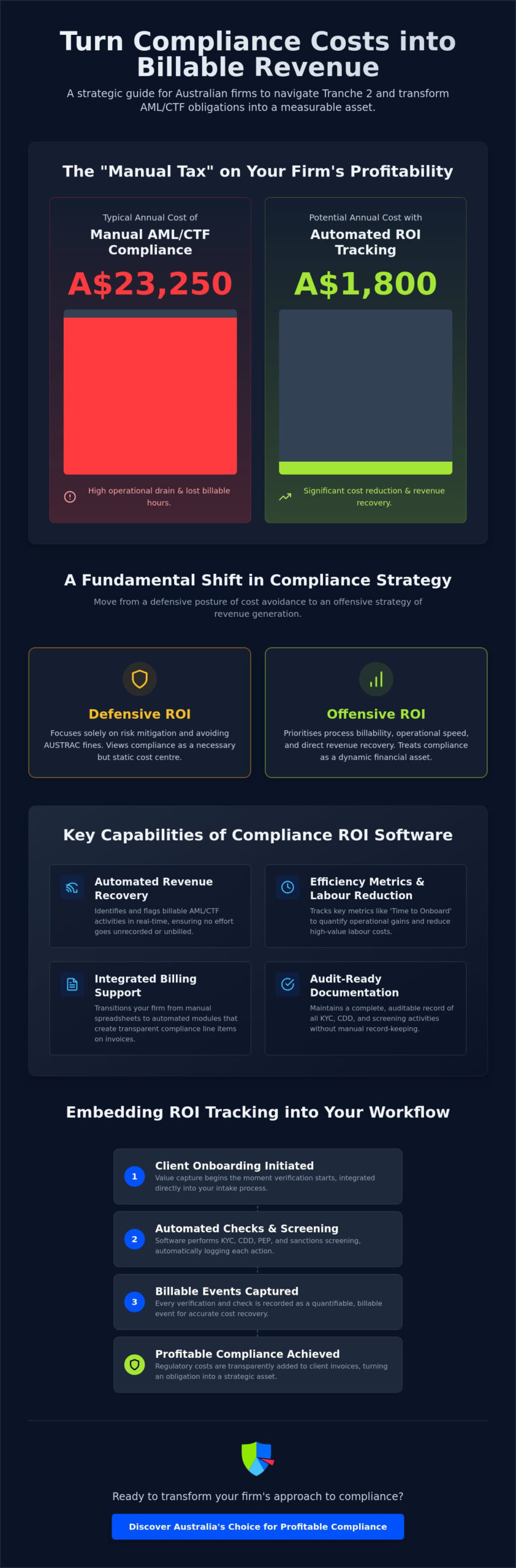
For many years, Australian professional services have viewed AML/CTF obligations as a “grudge purchase”. This perspective is shifting rapidly as firms realise that compliance is no longer a static cost centre. It’s a dynamic component of a firm’s financial health. By adopting compliance ROI tracking software, you transform these obligations into measurable assets. This transition requires a move away from “Defensive ROI”, which focuses solely on avoiding AUSTRAC fines, toward an “Offensive ROI” model that prioritises process billability and operational speed. True Return on Investment (ROI) in this space is the sum of risk avoidance, operational efficiency, and direct revenue recovery.
The Australian regulatory landscape is currently undergoing its most significant shift in a generation. With the full implementation of Tranche 2, the scrutiny once reserved for big banks now applies to lawyers, accountants, and real estate agents. Viewing these changes as a hurdle is a mistake. Instead, see them as an opportunity to audit your internal efficiencies. Firms that continue to rely on manual processes are essentially paying a “manual tax” that erodes their competitive edge. Automated systems don’t just keep you safe; they make you faster and more profitable.
The “Compliance Tax” vs. Strategic Investment
Manual KYC and CDD processes are often a hidden tax on your firm’s productivity. When a senior partner spends two hours manually verifying a complex trust structure, the firm loses more than just time; it loses high-value billable capacity. Manual record-keeping leaks profit through fragmented workflows and redundant data entry. Shifting to an automated approach creates a strategic advantage. It allows your most expensive resources to focus on advisory work while the software handles the heavy lifting of verification. This psychological shift from burden to advantage is what separates market leaders from those struggling with administrative bloat.
Why 2026 is the Tipping Point for ROI Tracking
The year 2026 marks a significant threshold for Australian firms as AUSTRAC increases its focus on non-financial sectors. Research indicates that a mid-market entity using manual approaches can incur roughly A$23,250 per year in operational costs. In contrast, automated solutions can reduce these costs significantly, often to below A$1,800 per year. Compliance ROI is the measurable financial benefit gained from automated regulatory systems versus manual labour costs. Using compliance ROI tracking software ensures that every minute spent on regulatory tasks is accounted for and, where possible, recovered. This level of transparency protects your profit margins and ensures your firm remains resilient in a high-scrutiny environment.
Core Features of Compliance ROI Tracking Software
Transitioning from manual oversight to automated tracking requires a specific set of technological capabilities. Effective compliance ROI tracking software must do more than just tick a box; it must function as a sophisticated financial instrument. It bridges the gap between administrative labour and revenue generation by capturing every minute spent on AML/CTF tasks. Whether it’s KYC verification or SMR filing, the platform ensures that no effort goes unrecorded. This granular data is essential for justifying the cost of compliance in Australia to both internal stakeholders and external clients.
Automated Revenue Recovery Modules
The most impactful feature of modern tracking software is the ability to identify billable events in real time. Instead of trying to reconstruct hours at the end of the month, the software flags each client verification and activity tracking event as it happens. This allows firms to categorise compliance as a transparent line item on invoices. It removes the friction between compliance officers and the accounts department, as the data is already validated and ready for billing. If you’re looking to streamline this process, exploring automated billing support can significantly improve your recovery rates and ensure your firm remains profitable during the Tranche 2 transition.
Efficiency Metrics and Labour Reduction
ROI isn’t solely about what you bill; it’s also about what you save. Tracking the “Time to Onboard” (TTO) provides a primary metric for your firm’s operational health. When you automate PEP and sanctions screening, you aren’t just reducing human error; you’re reclaiming hundreds of manual labour hours each year. Modern systems allow you to visualise these savings through intuitive dashboards. These tools compare the cost of manual intervention against the speed of automation, providing a clear picture of your internal efficiency gains.
Beyond simple tracking, the most advanced compliance ROI tracking software offers real-time dashboards that serve as a financial command centre. These visual tools allow partners to compare “Cost per Onboarding” against actual “Revenue Recovered” in a single view. This transparency ensures you aren’t just guessing at profitability but measuring it with precision. API connectivity further enhances this by allowing a seamless data flow between your compliance hub and your practice management software. This integration eliminates double-handling, which is a major source of profit leakage in traditional Australian firms. By synchronising these systems, you ensure that every KYC check and risk assessment is logged, tracked, and ready for audit without additional manual intervention.
Beyond the Spreadsheet: Automating Revenue Recovery
Relying on manual spreadsheets to manage AUSTRAC obligations is like using a paper map in a GPS world; it’s slow, prone to error, and ultimately unreliable. Many Australian firms still attempt to track their regulatory labour through basic Excel logs or manual time-sheets. This approach fails to capture the true cost of compliance because it depends on human memory and consistent data entry. When your team is busy, the fifteen minutes spent on a complex sanctions screen or a beneficial ownership check often goes unrecorded. These small, “forgotten” tasks quickly aggregate into a significant drain on your firm’s profitability.
The Pitfalls of Manual ROI Calculations
Manual tracking isn’t just inefficient; it’s a liability during an AUSTRAC independent review. Spreadsheets lack the robust audit trails and version controls required to meet modern regulatory standards. As your client volume increases with the expansion of Tranche 2, the administrative burden of manual entry becomes a bottleneck that stifles growth. Human error in time-logging leads to under-billing and opaque cost structures that are impossible to justify to clients. If you can’t prove exactly how much time was spent on a specific file, you can’t realistically expect to recover those costs. This is where compliance ROI tracking software becomes essential for maintaining financial accuracy.
Designing a Billable Compliance Framework
Shifting from a sunk-cost model to a revenue-generating one requires a clear strategy for client communication. You don’t have to hide compliance costs within your general overheads. Instead, you can present them as a value-added “Compliance Pack” or a “Verification Service” that ensures the client’s own regulatory safety. Using software-generated reports allows you to demonstrate the depth of work performed, from PEP screening to ongoing monitoring. This transparency builds trust and justifies the fee as a necessary component of professional service delivery. Automated ROI software converts administrative data into transparent, billable line items for professional services.
The logic is simple: move from a A$0 recovery model to a high-margin compliance service. By using compliance ROI tracking software, you gain the data needed to set fixed-fee compliance charges that cover both your software costs and your staff’s labour. This turns what was once a “manual tax” into a predictable revenue stream. Your firm stops absorbing the cost of regulation and starts leveraging its expertise as a billable asset. This transition doesn’t just protect your margins; it reinforces your position as a technologically advanced and compliant partner in the Australian market.
Integrating ROI Tracking into Your Firm’s Workflow
Successfully embedding compliance ROI tracking software into your firm’s daily operations requires more than just a new login. It demands a methodical approach to integration that starts at the very first client touchpoint. During the initial KYC phase, your software should automatically initiate a tracking protocol that captures every verification step, from identity checks to complex entity mapping. This ensures that the labour costs associated with high-risk client onboarding are never lost in the shuffle of a busy practice. By creating this automatic link between verification and record-keeping, you establish an unbreakable audit trail that simultaneously serves as a financial ledger for your accounts team.
Choosing the Right Integration Points
A critical decision involves identifying your “Master Data” source. While your CRM might hold basic contact details, your compliance platform should remain the definitive source for risk-based documentation. To avoid the profit-draining trap of duplicate data entry, ensure your compliance ROI tracking software syncs seamlessly with your existing practice management tools. This alignment allows audit-ready documentation to appear directly within your billing flow. When a partner reviews an invoice, they shouldn’t have to hunt for evidence of work performed; the automated sync ensures the data is already there, validated and ready for client presentation.
Overcoming Internal Resistance to New Software
Australian firms often face “software fatigue” when introducing new administrative layers. You can overcome this resistance by focusing on reducing AML compliance manual work through clear, demonstrated time-savings. It’s vital to prove ROI within the first 90 days of implementation. When staff see that automated screening replaces hours of manual Google searches and spreadsheet updates, their perspective shifts. They stop seeing compliance as a hurdle and start viewing it as a value-generating activity that protects the firm’s reputation and bottom line. If you’re ready to see these results in your own practice, you can optimise your firm’s compliance workflow today.
Training your team to recognise this value is the final step in a successful rollout. They need to understand that every minute logged by the system isn’t about surveillance; it’s about revenue recovery and risk mitigation. When compliance is framed as a billable asset, the culture of the firm evolves. Staff become more diligent because they see the direct link between their regulatory tasks and the firm’s financial health. This cultural shift, supported by robust automation, ensures your firm remains both profitable and fully prepared for the ongoing evolution of the Australian regulatory environment.
Why Trancher is Australia’s Choice for Profitable Compliance
Trancher stands as the premier end-to-end platform designed specifically for the Australian professional services sector. Unlike generic global tools, our system is finely tuned to the nuances of local regulations and the commercial realities of Australian firms. By implementing our compliance ROI tracking software, you gain more than just a security layer; you acquire a tool that prioritises your firm’s profitability. It’s a strategic guide that helps you navigate the complexities of AUSTRAC obligations with confidence and ease. We don’t just help you stay compliant; we help you stay profitable.
Our “Compliance Billing Support” feature set is a core component of this strategy. It provides the granular data necessary to support your ROI claims, ensuring that every verification and activity tracking event is documented to an audit-ready standard. This level of precision is backed by expert guidance from Australian compliance specialists who understand the local market’s unique pressures. They act as a steady hand, ensuring your firm doesn’t just meet requirements but thrives under them. This local expertise ensures that your workflows remain efficient and your documentation remains beyond reproach during any independent review.
The Trancher Difference: Built for Billability
The true value of our platform lies in how it automates the revenue and ROI tracking process natively. Every time your team files an AUSTRAC report or conducts a KYC check, the system captures the associated operational cost. This allows you to streamline reporting while simultaneously identifying opportunities for revenue recovery. We also provide integrated staff training to ensure your team maintains high standards, which directly correlates to a higher ROI on your compliance investment. By removing the administrative guesswork, we allow your partners to focus on high-value advisory work while the software manages the billable trail of regulatory labour.
Ready for Tranche 2 and Beyond
As we approach the significant legislative updates of 2026, future-proofing your firm is essential. Trancher is built to scale alongside your business, whether you are managing 50 clients or 5,000. It removes the friction of manual administrative work, allowing you to focus on growth without being held back by regulatory bloat. Our compliance ROI tracking software ensures that as your client list grows, your profit margins remain protected from the rising costs of manual oversight. You can see how Trancher can transform your compliance ROI today and ensure your firm remains a leader in the evolving Australian landscape.
Secure Your Firm’s Future with Measurable Compliance ROI
The transition toward the 2026 regulatory landscape doesn’t have to be a drain on your firm’s resources. By shifting from manual, opaque processes to a structured, automated framework, you can reclaim lost billable hours and protect your profit margins. We’ve explored how identifying billable events and integrating them into your existing workflow turns a regulatory burden into a strategic advantage. Implementing compliance ROI tracking software is the definitive step toward achieving this operational transparency and financial health.
Trancher is specifically designed for Australian Tranche 2 entities, offering built-in compliance billing and revenue tracking that manual systems simply cannot match. With our platform, you gain the peace of mind that comes from audit-ready documentation guaranteed to meet AUSTRAC standards. It’s time to stop absorbing the cost of regulation and start leveraging it as a professional asset. Book a personalised demo to see Trancher’s ROI tracking in action and discover how seamless your transition to profitable compliance can be. Your firm’s readiness is the foundation of its future growth and long-term resilience.
Frequently Asked Questions
How does compliance ROI tracking software actually save my firm money?
It saves your firm money by replacing high-cost manual labour with automated verification processes. By capturing every minute spent on KYC and screening, the software identifies billable events that are typically missed in manual logs. This ensures you’re recovering costs rather than absorbing them as overheads.
Can I legally bill my clients for AML/CTF compliance costs in Australia?
Yes, you can bill clients for these costs if you clearly disclose the charges in your engagement terms. Many Australian firms now include compliance as a transparent line item or a fixed-fee service. This approach ensures your clients understand the value of the regulatory safety you’re providing.
What are the most important ROI metrics to track for AUSTRAC compliance?
Focus on tracking your Time to Onboard (TTO) and the total cost per client verification. You should also monitor your revenue recovery rate, which compares the actual cost of compliance labour against the amount successfully billed back to clients. These metrics provide a clear picture of your firm’s operational efficiency.
How long does it take to see a return on investment from compliance software?
Most firms realise a positive return within the first 90 days of implementation. This rapid ROI is driven by the immediate reduction in manual screening hours and the introduction of automated billing support. As your team stops double-handling data, your profit margins begin to recover almost instantly.
Does ROI tracking software help with AUSTRAC independent reviews?
It significantly simplifies the review process by maintaining an automated, chronological log of all compliance activities. This “unbreakable” audit trail proves to reviewers that your firm has followed its AML/CTF program consistently. Having this data ready saves weeks of manual preparation time before an audit.
Is compliance ROI tracking software difficult to integrate with my current billing system?
Modern compliance ROI tracking software is designed to integrate seamlessly with existing practice management and billing tools via API. This connectivity ensures that compliance data flows directly into your billing cycle without the need for manual data entry. It removes the friction between your compliance and accounts departments.
What is the “cost of non-compliance” versus the cost of automation?
The cost of non-compliance involves substantial AUSTRAC fines and the risk of catastrophic reputational damage. In contrast, automation reduces the operational cost of compliance, which can be as high as A$23,250 per year for manual processes in mid-market firms. Automation is a fraction of that cost and provides far greater security.
How do I explain compliance fees to my clients using software data?
You can use the detailed reports generated by the software to show clients the specific work performed on their behalf. By presenting a “Compliance Pack” that lists screening and verification steps, you frame the fee as a professional service. This transparency builds trust and justifies the cost as a necessary safety measure.